Among all the papers included in the exam, UPSC GS Paper 1 seems to be the most familiar to the aspirants. This is because most of what aspirants are studying has already been covered during school or graduation. But familiarity ≠ an easy subject. Many students work tirelessly hard for History, Geography, and Society, yet score average marks because they lack direction. The point we’re trying to make is that GS Paper 1 is not conceptually difficult but can be strategically challenging. In this guide, we’ll focus on outlining a strategy for GS 1 preparation and on how you can succeed in this integral UPSC paper.
Understanding UPSC Mains GS Paper 1 Syllabus
The syllabus for the paper broadly includes:
- Indian Heritage & Culture
- Ancient, Medieval & Modern History
- World History
- Post-Independence India
- Indian Society
- Physical, Indian & Human Geography
Majorly, Paper 1 in UPSC isn’t only about recalling random facts. It expects aspirants to connect historical events, geographical concepts, and social issues with analytical reasoning and balanced perspectives.
History Strategy
History takes up the major chunk of the GS Paper 1, so it requires a clear preparation strategy.
Focus Areas
- Ancient History
- Medieval History
- Modern History (Recurring)
- Indian Freedom Movement
How to Prepare
Don’t just memorize dates and plain facts. Focus on:
- Causes
- Consequences
- Historical significance
- Long-term impact
Common Mistakes
- Memorizing dates without understanding the broader historical context.
- Ignoring nationalism, reforms, and socio-political movements
- No regular revision
Art & Culture Strategy
This particular section might catch aspirants off-guard because of its factual nature. However, the aim is to systematize the preparation to manage results.
Important Areas
- Architecture
- Temple styles
- Paintings
- Dance forms
- Music
- Literature
- UNESCO heritage sites
Repeated Revision > Excessive Reading
World History Strategy
World History is a comparatively smaller section of the paper, but can be high-scoring if preparation is properly aligned with major developments such as:
- Industrial Revolution
- American Revolution
- French Revolution
- World Wars
- Colonisation
- Decolonisation
- Political ideologies
Understanding Global Modern Impact > Memorizing Timelines
Post-Independence India Strategy
Though the syllabus is limited, the section shouldn’t be taken lightly. The following important topics should be included in the preparation:
- Nation building
- Integration of princely states
- Economic reforms
- Political developments
- Social transformation
Indian Society Strategy
Society is one of the most dynamic and scoring sections of GS Paper 1. Unlike a few other sections, Society is completely averse to memorization.
Important Topics
- Diversity
- Women and gender issues
- Population
- Urbanisation
- Globalisation
- Poverty
- Social empowerment
Preparation Strategy
Integrate:
- Current affairs
- Government initiatives
- Committee recommendations
- Practical examples
Contemporary examples ↑ ∝ Stronger Answers ↑
Geography Strategy
Geography is the combination of conceptual understanding + practical application. The syllabus consists of:
- Physical Geography
- Indian Geography
- Human Geography
- Resources
- Disaster Management
- Environmental issues
How to Prepare
Strengthen your answers with conceptual clarity and the following visual elements:
- Maps
- Diagrams
- Flowcharts
Important: Maps instantly improve your answer quality because of better geographical concept understanding.
GS Paper 1 Answer Writing Strategy
An effective answer should follow a simple structure:
| IntroductionDefinitionContextHistorical referenceConstitutional or geographical relevance |
| BodyMultiple dimensionsCausesImpactsChallengesSolutions (where applicable) |
| ConclusionBalanced summaryWay forwardPositive outlook |
| Value Addition TechniquesMapsFlowchartsDiagramsConstitutional referencesGovernment reportsCurrent examples |
How to Use Previous Year Questions (PYQs)
GS Paper 1 previous year questions are the best preparation instrument for UPSC aspirants. However, it is a weak approach to only practice with PYQs. The better technique is to analyze every question and identify:
- Repeated themes
- Directive words
- Analytical depth expectations
- Consistent topics
PYQs are a great way to tap into an examiner’s mindset, which will help you prepare more strategically.
Exclusive Insights
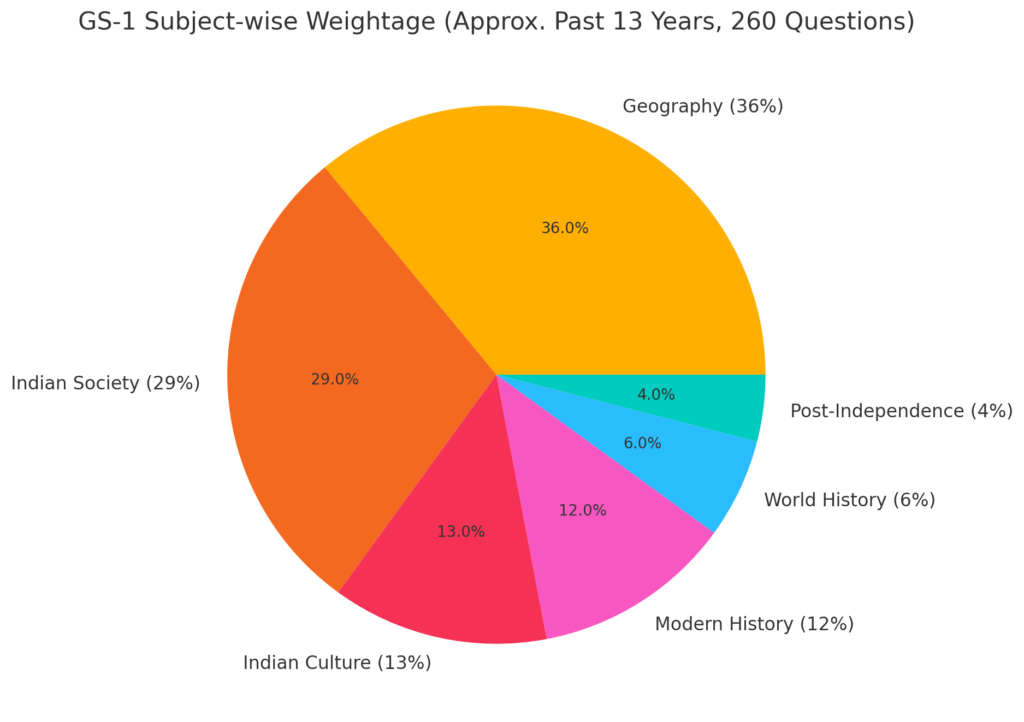
Over the past 13 years, out of approximately 260 GS-1 questions:
- Geography accounts for the largest share with about 36% (≈93 questions)
- Indian Society at around 29% (≈75 questions)
- Culture contributes 13% (≈34 questions)
- Modern History about 12% (≈31 questions)
- World History makes up 6% (≈16 questions)
- Post-Independence about 4% (≈11 questions)
Overall, the analysis shows that Geography and Society dominate GS-1, making them the top-priority areas for preparation.
Revision Strategy
Given the breadth of the GS Paper 1 syllabus, aspirants should focus on systemizing the revision. Here is the cyclic revision pattern recommended by the best online coaching for UPSC:
Cycle 1: Complete subject-wise revision after each section.
Cycle 2: Leverage your notes and mind maps for revision.
Cycle 3: Rapid revision stage—PYQs, answer writing, and weak topics.
The whole goal of these revision cycles is to retain what you have learned and not add new resources.
Common Mistakes to Avoid
Students should avoid the following mistakes, especially when focusing on History Geography Society for UPSC Mains answers:
- Ignoring Society while over-preparing History
- Memorising facts without analysis
- Not using maps in Geography answers
- Weak introductions and conclusions
- Ignoring Previous Year Questions
- Lack of revision
- Poor answer structure
Three-Month UPSC GS Paper 1 Preparation Strategy Plan
| Month 1 | Month 2 | Month 3 |
| Modern History | Geography | World History |
| Ancient & Medieval History | Art & Culture | Post-Independence India |
| Society basics | Continue answer writing | PYQs |
| Multiple revision cycles |
Conclusion
Preparing for the UPSC Mains 2026 GS Paper 1 can get tricky if a clear path is not followed. Just because the paper focuses a lot on History does not mean that the strategy should only include rote memorization of facts. It is about studying intelligently, revising consistently, and writing analytical answers.
This guide is your complete step-by-step plan for the preparation of UPSC Mains GS 1. If you are still struggling with stepping ahead, you can take the help of the best UPSC online coaching in Hyderabad, like AKS IAS, and they shall help with answer evaluation, test series, mentorship, and personalized feedback.
Frequently Asked Questions (FAQs)
What comes in GS Paper 1?
In the UPSC Civil Services Mains Examination, GS Paper 1 covers Indian Heritage and Culture, History of the World and Society, and Geography.
How to prepare GS Paper 1 for UPSC Mains?
The preparation for GS Paper 1 should focus on:
- Building conceptual clarity
- Integrating current affairs + static concepts
- Analyzing PYQs
- Practicing answer writing
- Revising notes multiple times
What is the difficulty level of GS Paper 1?
Though the exact difficulty would be difficult to mention, aspirants generally rank it from moderate to difficult. However, if you follow the GS Paper 1 strategy for UPSC Mains 2026 enclosed in this guide, it becomes relatively easy.