Anthropology and sociology are among the most confusing optional subject choices in UPSC Mains. Both are popular choices, but their syllabi, concepts, answer-writing approaches and preparation requirements are different. Moreover, students are looking for the best optional subject for UPSC among the two. In this blog, we’ll uncover the truth behind this confusion and what fits best according to your approach towards the UPSC Mains exam.
Anthropology vs Sociology: What Is the Basic Difference?
In the simplest terms, the subjects can be defined as follows:
Anthropology = Human evolution + biological concepts + culture + society + tribes + Indian anthropology
Sociology = Social theory + thinkers + institutions + social structure + Indian society + contemporary issues
If you think you can rule out a higher-scoring subject through their descriptions, it doesn’t work that way. The question is whether the subject’s way of approaching problems suits you.
Anthropology vs Sociology UPSC: Syllabus Comparison
| Factor | Anthropology | Sociology |
| Core focus | Human beings, evolution, culture and society | Society, institutions and social relationships |
| Subject nature | Interdisciplinary | Social-science and theoretical |
| Biological component | Significant | Limited |
| Thinkers | Important | Very important |
| Indian society | Strong | Very strong |
| Tribal studies | Major component | Present but less central |
| Diagrams | Useful in several topics | Less central |
| Current affairs | Particularly useful for Paper II | Important for Paper II and applications |
| Answer style | Structured, conceptual and often diagram-supported | Analytical, theory-based and example-supported |
| Revision | Concepts, facts, scholars and diagrams | Concepts, thinkers, theories and examples |
| GS overlap | Strong in selected areas | Strong, especially with Indian Society |
| Suitable background | Can work well for varied backgrounds | Can work well for varied backgrounds |
What Does Anthropology Optional UPSC Preparation Involve?
| Paper I | Paper II |
| Human evolution | Indian culture and civilisation |
| Primates | Indian social structure |
| Human genetics | Tribal communities |
| Biological anthropology | Tribal development |
| Human variation | Tribal problems |
| Culture | Constitutional safeguards |
| Society | Caste |
| Marriage | Rural and urban communities |
| Family | Population-related issues |
| Kinship | Applied anthropology |
| Economic organisation | |
| Political organisation | |
| Religion and magic | |
| Social change | |
| Anthropological theories and thinkers | |
| Research methods |
Anthropology would require you to switch between scientific concepts and social analysis.
What Does Sociology Optional UPSC Preparation Involve?
| Paper I | Paper II |
| Sociology as a discipline | Caste |
| Research methods | Tribe |
| Social stratification | Class |
| Social mobility | Family and kinship |
| Work and economic life | Religion |
| Politics and society | Rural society |
| Religion | Urbanisation |
| Family and kinship | Industrialisation |
| Social change | Social movements |
| Social movements | Population |
| Sociological thinkers and theories | Education |
| Gender | |
| Globalisation | |
| Social change | |
| Development |
Sociology isn’t about naming/describing philosophers. It is about understanding what a thinker argued, what concept it explains and how that concept can be applied to a question — all for the likes of Karl Marx, Émile Durkheim and Max Weber.
Anthropology vs Sociology: Which Has More GS Overlap?
| UPSC Area | Anthropology | Sociology |
| GS Paper I – Indian Society | Strong | Very strong |
| GS Paper II – Social Justice | Useful | Strong |
| GS Paper III – Development/Tribal issues | Useful | Some overlap |
| GS Paper IV – Ethics | Indirect | Conceptual overlap |
| Essay | Useful | Strong |
| Current Affairs | Strong in Indian/tribal topics | Strong across social issues |
It is important to note that GS overlap should only be treated as an advantage and not the sole deciding factor. All IAS coaching in Hyderabad, for instance, will try to connect the optional subject with GS papers for effective preparation.
Anthropology vs Sociology: How Is Answer Writing Different?
| Anthropology Answer-Writing Framework | Sociology Answer-Writing Framework |
| DefinitionConcept – clarityExplanation – technical terminologyDiagram/Flowchart – structured presentationExample – relevantApplication – Indian, where applicableConclusion | DefinitionThinker/Theory – sociologistExplanationContemporary ExampleIndian ContextCritical AnalysisConclusion |
Which Is Easier to Revise?
No optional subject for UPSC can be said to be easier to revise than the other. It’s just the scope of revision that changes across both—the same has been highlighted in the table below.
| Anthropology | Sociology |
| Definitions | Definitions |
| Concepts | Concepts |
| Scholars | Thinkers |
| Classifications | Indian sociologists |
| Diagrams | Theories |
| Tribal case studies | Social issues |
| Indian examples | Contemporary examples |
| Technical terminology | Applications |
The only practical difference between the two is the approach you take towards the revision of each paper.
Anthropology revision = concepts + facts + scholars + diagrams
Sociology revision = concepts + thinkers + theories + examples
This does not make any subject require less revision.
Is Anthropology or Sociology More Scoring?
No optional subject among the two is universally “more scoring.” That also amplifies the fact that there isn’t a single best optional for UPSC. Some might tell you that UPSC has recognized a range of students scoring extravagantly in particular subjects. But that does not mean it will also work for you. Marks depend on factors such as:
- Understanding of the syllabus
- Question selection
- Answer quality
- Conceptual clarity
- Examples
- Presentation
- Revision
- Test practice
- Individual preparation
Therefore, don’t select an optional purely because someone calls it “high scoring.”
Which Optional Suits You?
| Choose Anthropology if you | Choose Sociology if you |
| Comfortable with biological concepts | Enjoy social theory |
| Like diagrams | Like understanding society |
| Prefer structured material | Comfortable with thinkers |
| Find human evolution and genetics interesting | Enjoy contemporary social issues |
| Comfortable studying social and tribal topics | Prefer analytical writing |
How Does the Optional Fit Into a Study Plan for UPSC Mains?
| Phase | Focus Elements |
| Foundation Phase | Understand the syllabusComplete basic sourcesAnalyse PYQsCreate topic-wise notes |
| Consolidation Phase | Complete Paper IComplete Paper IIStart regular answer writingAdd examples and current affairs |
| Revision Phase | Revise short notesSolve PYQsPractise timed answersIdentify weak topics |
| Test Phase | Write sectional testsPractise full-length papersAnalyse mistakesRevise repeatedly |
If you are pursuing UPSC online coaching, they’ll ensure that these are essentially incorporated into your study plan for UPSC Mains.
Conclusion
Your search for the best optional subject will get you nowhere. What looks like working towards clarity will generally amplify your confused state even more. Everyone has a different answer to the same question, and that’s exactly how you should also look at it. Use a practical test:
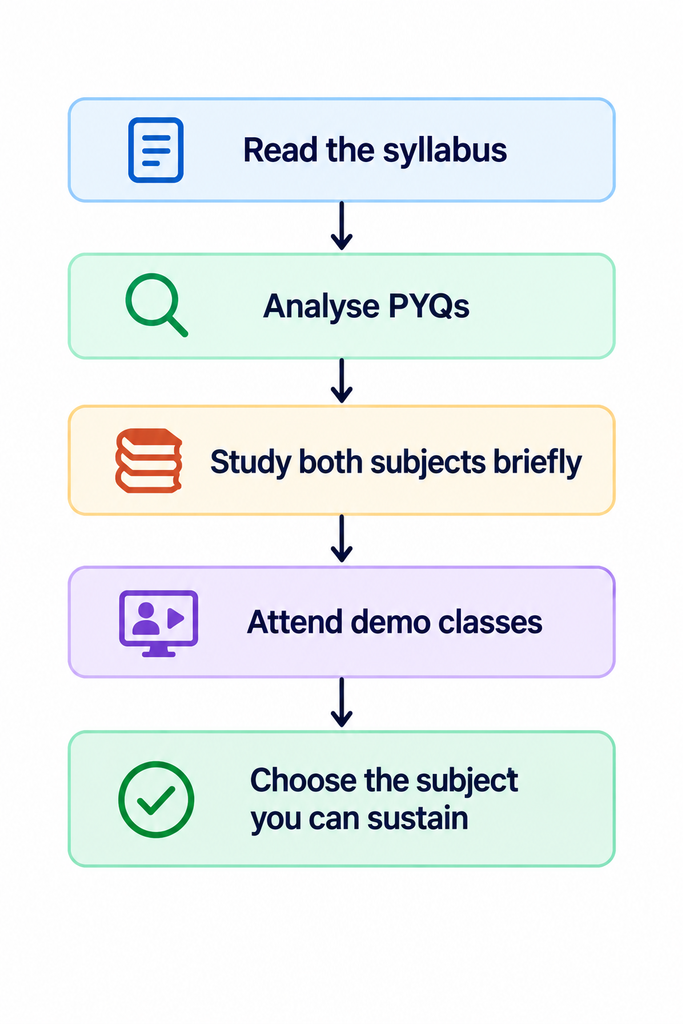
Ultimately, if you face greater confusion, you can consult the best UPSC coaching in Hyderabad, like AKS IAS, for instance. The faculty can help you find the best choice for you and create a study plan for the same.
Frequently Asked Questions (FAQs)
Which is better for UPSC, sociology or anthropology?
There is no universally better option. The choice should depend on your academic comfort, interest, learning style, answer-writing ability, revision capacity and familiarity with the syllabus.
Is Anthropology good optional for UPSC?
Yes, if you find biological and structured components comfortable.
Is sociology a good option for UPSC?
Yes, if you are interested in understanding theories, thinkers and contemporary social issues.