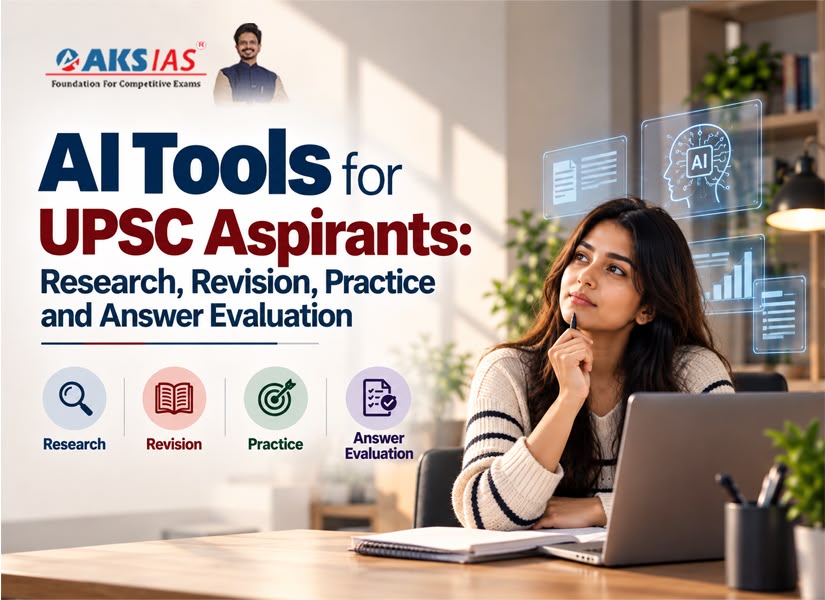
Artificial intelligence (AI) has changed how UPSC aspirants go about their preparation. They are not solely dependent on books and traditional resources for everything, from researching a complex topic and simplifying difficult concepts to generating practice questions, creating revision exercises and reviewing Mains answers.
However, aspirants need to understand that they should still be the final learner. The overuse of AI shouldn’t take away their ability to understand, write answers in exams, and improve evaluation. But used correctly, AI can function as a study assistant, research partner, revision tool and practice companion throughout your preparation. In this guide, we’ll discuss the top AI tools for UPSC preparation and how AI fits into an aspirant’s preparation workflow.
Best AI Tools for UPSC Preparation: What Should You Use Them For?
| AI tool | Potential UPSC use |
| ChatGPT | Concept learning, revision, quizzes, practice and answer feedback |
| Gemini | Research, synthesis and document-based tasks |
| Perplexity | Web research and source discovery |
| NotebookLM | Working with your own notes, PDFs and study material |
| Other AI assistants | Writing, analysis, brainstorming and supplementary practice |
ChatGPT
ChatGPT is among the most popular AI tools in the market since the time it has been launched. In UPSC’s context, it can be used to:
- Explain difficult concepts
- Break down broad topics
- Ask you questions
- Generate revision quizzes
- Create flashcards
- Analyse PYQs
- Generate supplementary MCQs
- Simulate Mains questions
- Review your answers
- Identify recurring weaknesses
ChatGPT now has a special study mode especially made for students where the AI tool puts on the hat of a teacher to explain concepts step-by-step, and ask follow-up questions to direct students towards answers. Write detailed prompts where you ask the tool to follow up with questions.
Gemini
If you want to dive into the research of something, Gemini does a great job. The deep research facility provided by Gemini is an excellent in-depth document research tool with a synthesized response. For UPSC preparation, this can be useful when researching topics such as:
- India’s semiconductor ecosystem
- Climate finance
- India’s neighbourhood policy
- Agricultural reforms
- Artificial intelligence governance
- Urbanisation
- Public health
- International organisations
Provide a standardized research framework, and the quality of outputs will improve drastically.
Perplexity
Another great tool for research-heavy preparation. Sourcing is the unique proposition of Perplexity and can particularly be useful for:
- Finding reports
- Locating statistics
- Identifying government sources
- Comparing sources
- Researching current issues
- Finding background information
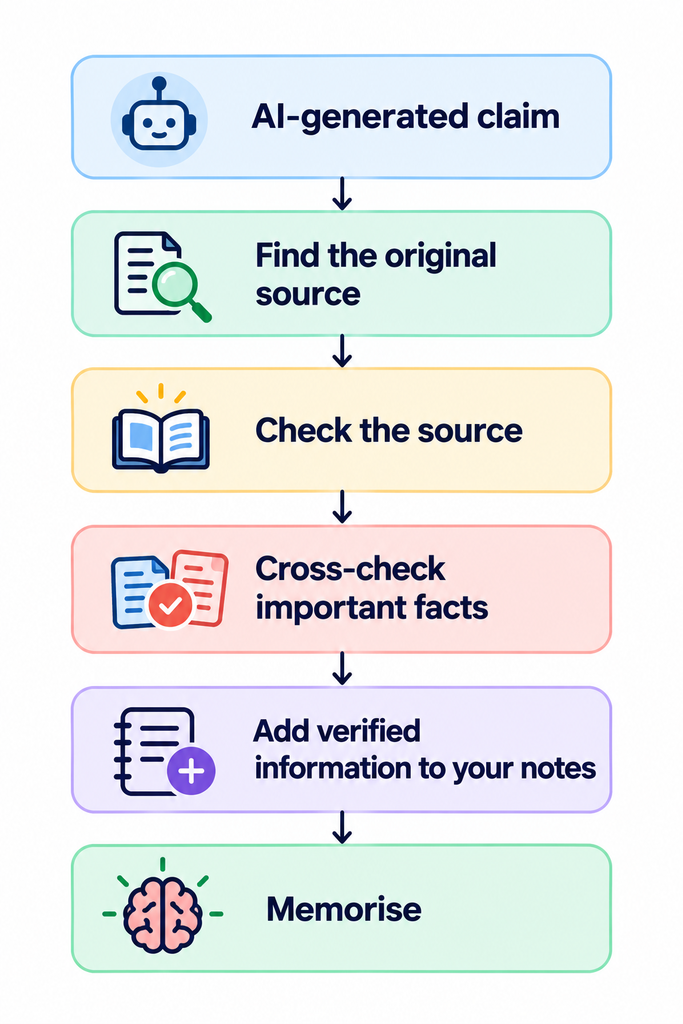
But don’t stop at the AI-generated answer. Open the source and verify important facts before putting them into your UPSC notes.
NotebookLM
It can help you enhance your self-owned study material with notes, mind maps and Audio Overviews. You could use it with:
- Your class notes
- Standard study material
- Government reports
- PDFs
- Personal revision notes
- Previous-year papers
This could be great for UPSC revision.
How to Use AI for UPSC Research
| Step 1Break down the topic | Step 2Identify reliable sources | Step 3Convert research into examination material |
| Causes | Government reports | Map it to the UPSC syllabus |
| Environmental dimensions | Ministry documents | Connect it with PYQs |
| Governance challenges | Parliamentary material | Key facts |
| Infrastructure issues | NITI Aayog reports | Examples |
| Social impacts | International organisation reports | Data points |
| Economic impacts | Relevant research papers | Case studies |
| Climate connections | Arguments | |
| Solutions | Challenges | |
| Case studies | Solutions | |
| Possible Mains questions |
How to Use AI for UPSC Revision
Most aspirants undermine the use of AI tools in revision. Accordingly, they only use it to generate passive recall summaries. But it can be used actively to retrieve information from memory, which is more useful for revision. AI helps you create:
| Flashcards | Revision quizzes |
| Constitutional articles | Easy questions |
| Definitions | Moderate questions |
| Thinkers | Difficult questions |
| Government schemes | Mixed-topic questions |
| Reports | Apart from these, you can also prompt the tools for weak areas and revision around spaced intervals. |
| Important committees | |
| Case studies | |
| Data points |
How to Use AI for UPSC Prelims Practice
AI can also be great at generating MCQs for supplementary practice through:
- Explaining incorrect answers
- Identifying conceptual mistakes
- Analysing elimination errors
- Generating another set focused on weak areas
It is important to note that they are only supplementary in nature and should not be taken as a replacement for actual UPSC PYQs. They provide you with insights into patterns actually followed by the official UPSC examinations. A useful cycle is:
PYQs → AI-generated supplementary practice → Error analysis → Revision → PYQs again
How to Use AI for UPSC Mains Answer Writing
- Generate a practice question
- Write without AI
- Evaluate your own answer using relevant independent criteria
- Get AI feedback
- Rewrite according to feedback (that’s your final reference)
AI Answer Evaluation for UPSC: A Practical Framework
| Evaluation area | What to check |
| Question demand | Did the answer address every part? |
| Content | Are the facts and concepts relevant? |
| Structure | Is the answer logically organised? |
| Analysis | Does it explain causes, effects or implications? |
| Examples | Are examples specific and relevant? |
| Dimensions | Has the answer considered multiple perspectives? |
| Presentation | Are headings, diagrams or flowcharts useful? |
| Conclusion | Does it provide a relevant closure? |
What Can AI Actually Evaluate in a UPSC Answer?
- Question demand
- Structure
- Content gaps
- Examples
- Repetition
- Conclusion
However, the feedback should be termed as practice feedback—not at the standards of official UPSC evaluation. The faculty of the top UPSC online courses can generally offer such evaluation.
How to Use AI Without Becoming Dependent on It
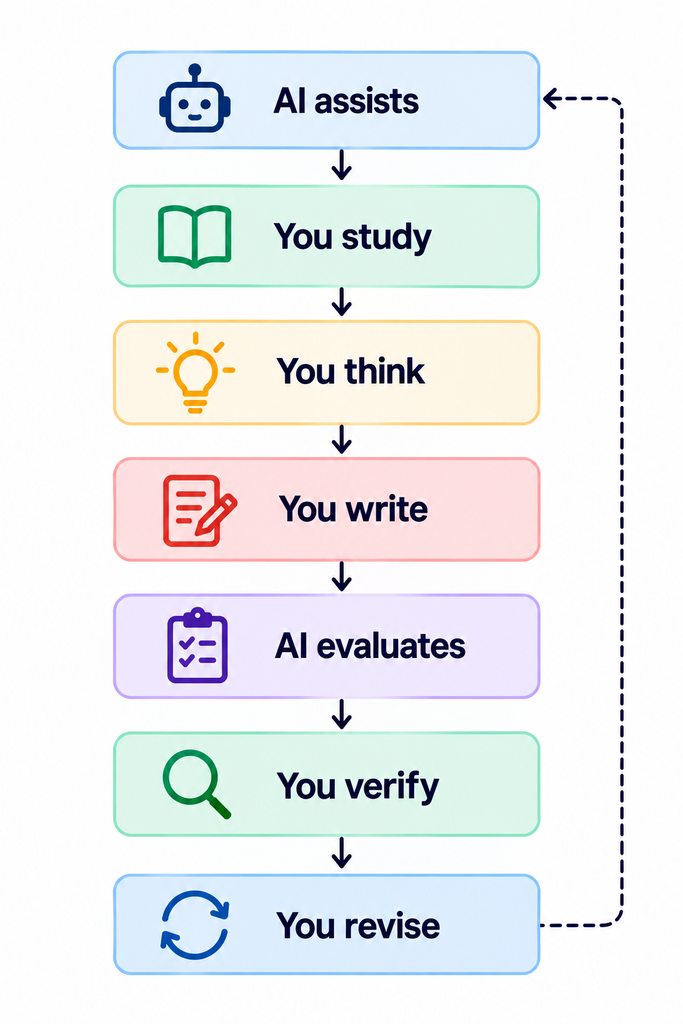
The role of AI in UPSC preparation should be limited to that of an assistant. You should still take over the major part of what goes behind it.
Risks of Using AI for UPSC Preparation
- Hallucinated information – looks convincing, but is incorrect
- Incorrect citations – open source for crucial information
- Outdated information – check the date and source
- Generic Mains answers – polished answer ≠ good UPSC answer
- Overdependence – retain the thinking part
- False confidence – error-containing fluent explanations
- Privacy concerns – personal information should be uploaded carefully
Follow the “Verify Before You Memorise” Rule
Always ensure the following flow for UPSC preparation using AI:
How to Write Better AI Prompts for UPSC
Writing better AI prompts is what nudges the tool to replicate the expertise of the best UPSC coaching in Hyderabad, for instance. A useful formula to write good prompts is:
Role + Context + Task + Constraints + Output format
For example:
“You are helping me prepare for UPSC GS-II. I am studying the anti-defection law. Explain its constitutional basis, important judicial developments, limitations and possible reforms. Separate static concepts from current-affairs examples and identify facts that require verification.”
How AI Fits Into a Complete UPSC Preparation Workflow
| UPSC task | AI-assisted approach |
| Research | Topic breakdown and source discovery |
| Current affairs | News-to-syllabus mapping |
| Note-making | Organising and condensing material |
| Revision | Active recall and quizzes |
| Prelims | Supplementary MCQs and error analysis |
| Mains | Question generation and answer feedback |
| Essay | Brainstorming and counterarguments |
| Ethics | Case-study practice |
| Optional | Concept explanation and PYQ analysis |
| Planning | Study scheduling and progress review |
The key word is assisted. This also means that you can continue your preparation with the UPSC online coaching classes in Hyderabad, for instance, while taking periodic help from AI tools.
The 4R Framework for AI-Powered UPSC Preparation
| Research | Recall | Respond | Review |
| Explore topics | Quizzes | MCQs | Evaluate answers |
| Find sources | Flashcards | Mains questions | Identify gaps |
| Organise information | Active recall | Essays | Analyse recurring mistakes |
| Connect current affairs with the syllabus | Spaced revision | Ethics case studies | Improve structure |
And one principle sits above all four:
Verify.
- Research should be verified.
- Facts should be verified.
- Citations should be verified.
- Current affairs should be verified.
Conclusion
AI can change how you go forward with UPSC preparation. It can act as a great assistant you have by your side at all times. But when it comes to the final learning, you still need to read, think, write, revise and verify. This does not devalue the UPSC institutes in Hyderabad, like AKS IAS, for instance. They can still teach you to read, think, write, revise and verify.
Frequently Asked Questions (FAQs)
Can AI crack UPSC?
AI cannot crack the UPSC exam on its own, but it has become a powerful tool for aspirants to prepare, practice, and refine their strategies.
Is ChatGPT good for UPSC?
ChatGPT can be a useful secondary research assistant for UPSC preparation if used with caution. However, don’t count it as a complete replacement.
Which AI app is best for UPSC?
The best AI apps for UPSC include ChatGPT, Gemini, Perplexity, NotebookLM, etc.