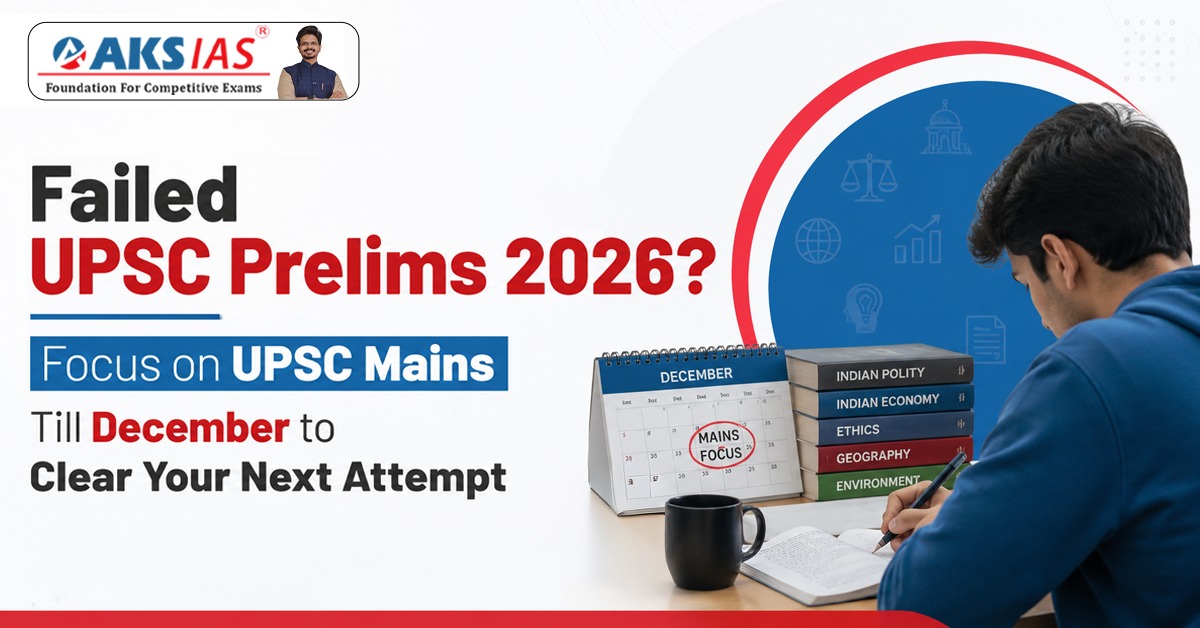
Prelims 2026 results have been officially released. While many students would have succeeded, failure is a common outcome for many aspirants. It might be overwhelming to handle failure at first; however, aspirants need to rethink, reassess, and bounce back. What differentiated success from failure in the results was not just more hard work. It was issue identification and preparation alignment.
The intuitive next step would feel like starting the preparation for Prelims again. But that’s a waste of effort. You have already covered a chunk of the Prelims syllabus. Even if you put a little effort into rectification of mistakes, you can clear the Prelims exam in the next attempt. However, wasting the initial months for that small rectification incurs opportunity cost—time you could have put to Mains preparation. The approach is to segment the UPSC Mains preparation strategy to include Mains and Prelims preparation. In this guide, we’ll help you understand what went wrong and how you can realize your full potential.
Failed UPSC Prelims? Here’s What You Should Do First
If you have unfortunately failed the UPSC exam, you should definitely avoid these emotional decisions that can negatively impact your next attempt:
- Compare your score with everyone else.
- Buy new books immediately.
- Change all your resources.
- Assume you aren’t capable of clearing UPSC.
- Spend weeks watching strategy videos instead of studying.
Instead of indulging in negative self-talk or actions that add no value to your next strategy, do the following things:
- Accept the result objectively.
- Take a short mental break.
- Gather your answer sheets and mock test records.
- Begin analysing your preparation.
- Segment your preparation into Mains & Prelims papers.
Why Do Candidates Fail in UPSC Prelims?
As we discussed, the line between success and failure isn’t only hard work. There are multiple constants involved responsible for it. Let’s examine the most common ones.
- Weak Conceptual Clarity
Many aspirants think that just hard memorization of facts will be enough to succeed in the UPSC. But conceptual knowledge should be a UPSC aspirant’s priority, irrespective of Mains or Prelims. It’s because when you are faced with statement-based questions, elimination techniques, and application-oriented MCQs.
- Poor Revision
Revision is frequently undervalued by UPSC aspirants. Many students focus on only reading new material, but revision is more important than new information. Introduce a new UPSC revision strategy into your preparation.
- Weak Mock Test Analysis
A common mistake students make is being lenient with the analysis of their mock tests. The goal is to scrutinize your mock papers as much as you can to prepare for the actual exams. Additionally, you shouldn’t just move on to mock tests. Evaluate using this UPSC mock test analysis framework:
Knowledge Mistakes – Questions you genuinely didn’t know.
Silly Mistakes – Errors caused by carelessness.
Guessing Mistakes – Questions attempted without sufficient elimination.
Time Management Issues – Questions left unanswered despite knowing them.
- Ignoring CSAT Preparation
One of the primary mistakes to avoid is to ignore preparation for the Civil Services Aptitude Test (CSAT). Every year, aspirants perform outstandingly in General Studies but lag behind in this subject, making it one of the most common reasons for failure.
- Information Overload in Current Affairs
Current affairs are one of the main things that students are concerned about. However, they irrationally increase their sources of information due to this concern. We are talking about:
- Multiple newspapers
- Several monthly magazines
- Numerous YouTube channels
- Multiple Telegram groups
What happens? Information ↑ Retention ↓
- Poor Exam-Hall Strategy
Sometimes, UPSC preparation is not the culprit. Planning also fails if the execution fails. Common mistakes would include:
- Spending too much time on difficult questions
- Excessive guessing
- Poor time management
- Panic during the exam
That’s why regular mock tests are so important.
A Proven Strategy With Initial Focus on Mains
It’s important that you focus on Mains preparation. If you focus on Prelims, two issues will arise:
- The Mains syllabus remains unfinished.
- The short gap between Prelims and Mains becomes extremely stressful.
Instead, segment your learning: focus for the first 6 months on the UPSC Mains syllabus, and then shift to Prelims preparation. Also, when you prepare for Prelims, you automatically strengthen:
- Static subjects
- Conceptual clarity
- Current affairs strategy
- Analytical thinking
- Answer writing skills
Strong Mains preparation often creates a stronger Prelims foundation. The reverse is not always true.
Pillar 1: Complete Your Optional Subject Before January
Postponing optional subject preparation until the end is the biggest mistake you can make. Optional subject results are one of the primary reasons for future failure. You should understand that an optional subject paper also carries the same weightage as a general paper. That’s why you should focus on achieving the following before January:
- Complete the syllabus.
- Revise every major topic.
- Practice answer writing regularly.
- Prepare topic-wise revision notes.
You should understand that preparing for optional subjects early on gives you more time to dedicate to Prelims preparation.
Pillar 2: Strengthen Your UPSC Essay Preparation
The essay is one of the highest-scoring papers when prepared consistently. But most students focus on it just before the Mains exam. Use the first 6 months after Prelims results to:
- Write one essay every week.
- Collect examples from current affairs.
- Maintain a repository of quotations.
- Practice structuring introductions and conclusions.
- Develop balanced arguments on social, political, economic, and ethical issues.
Pillar 3: Cover GS-I to GS-IV Thoroughly
| Paper | Focus |
| GS-I | History, Geography, Society |
| GS-II | Polity, Governance, International Relations |
| GS-III | Economy, Environment, Science & Technology, Internal Security |
| GS-IV | Ethics, Integrity, Aptitude |
Understanding > Memorization
Pillar 4: Solve UPSC Previous Year Questions
UPSC Mains PYQs are one of the greatest tools for preparation. But the solution is not the main thing—analysis is of more importance. With every paper, identify patterns by asking:
- Which themes are repeated?
- How does UPSC frame analytical questions?
- What depth of explanation is expected?
- Which topics appear frequently?
The aim is to understand the examiner’s expectations and prepare accordingly.
Pillar 5: Prepare Your Own UPSC Mains Notes
In this digital age, getting your hands on notes is very simple. It is available across Telegram, WhatsApp, and other resources. But the catch is that those notes were prepared for someone else’s goals. Prepare your own well-organized notes. The main components of such notes are:
- Short
- Topic-wise
- Easy to revise
- Updated with current affairs
- Rich in examples and value addition
Pillar 6: Build a Daily Answer Writing Habit
If you had to take only one piece of advice from this guide, you should take away the UPSC Mains answer writing practice. Knowledge is important, but if you are not able to present it the same way, it makes no sense.
- Start with – 2 answers every day
- Increase to – 4-5 answers daily
Focus on understanding directive words, structuring introductions, analytical body content, and balanced conclusions. Answer-writing practice helps aspirants build confidence, speed, and clarity.
Suggested UPSC Study Plan
| Timeline | Primary Focus |
| July-August | Optional Subject, GS Foundation, Notes |
| September-October | GS Completion, Essay, PYQs, Answer Writing |
| November-December | Revision, Optional Revision, Notes Consolidation |
| January-Prelims | Exclusive Prelims Preparation, Mock Tests, CSAT, Revision |
| After Prelims | Resume Mains Preparation Immediately |
Conclusion
If you failed UPSC Prelims 2026, don’t get discouraged. Consider it a learning experience that provides valuable feedback. However, you should not hold off on Mains preparation. Segment your preparation timeline, and also equally focus on Mains initially to reduce pressure later. You can add Prelims preparation later in your timeline. If you want more such insights, you can connect with guidance partners like AKS IAS that help you with end-to-end successful preparation.
Frequently Asked Questions (FAQs)
What happens when you fail Prelims?
Failing the prelims means you are immediately disqualified from that year’s selection cycle. You won’t be allowed to take the Mains exam.
What to do after failing UPSC Prelims?
After failing UPSC, you should accept the reality and reflect on the experience for improvement. Don’t engage in negative self-talk or comparisons.
Can I clear UPSC after failing Prelims?
Yes—but only if your next attempt is different from your previous one.