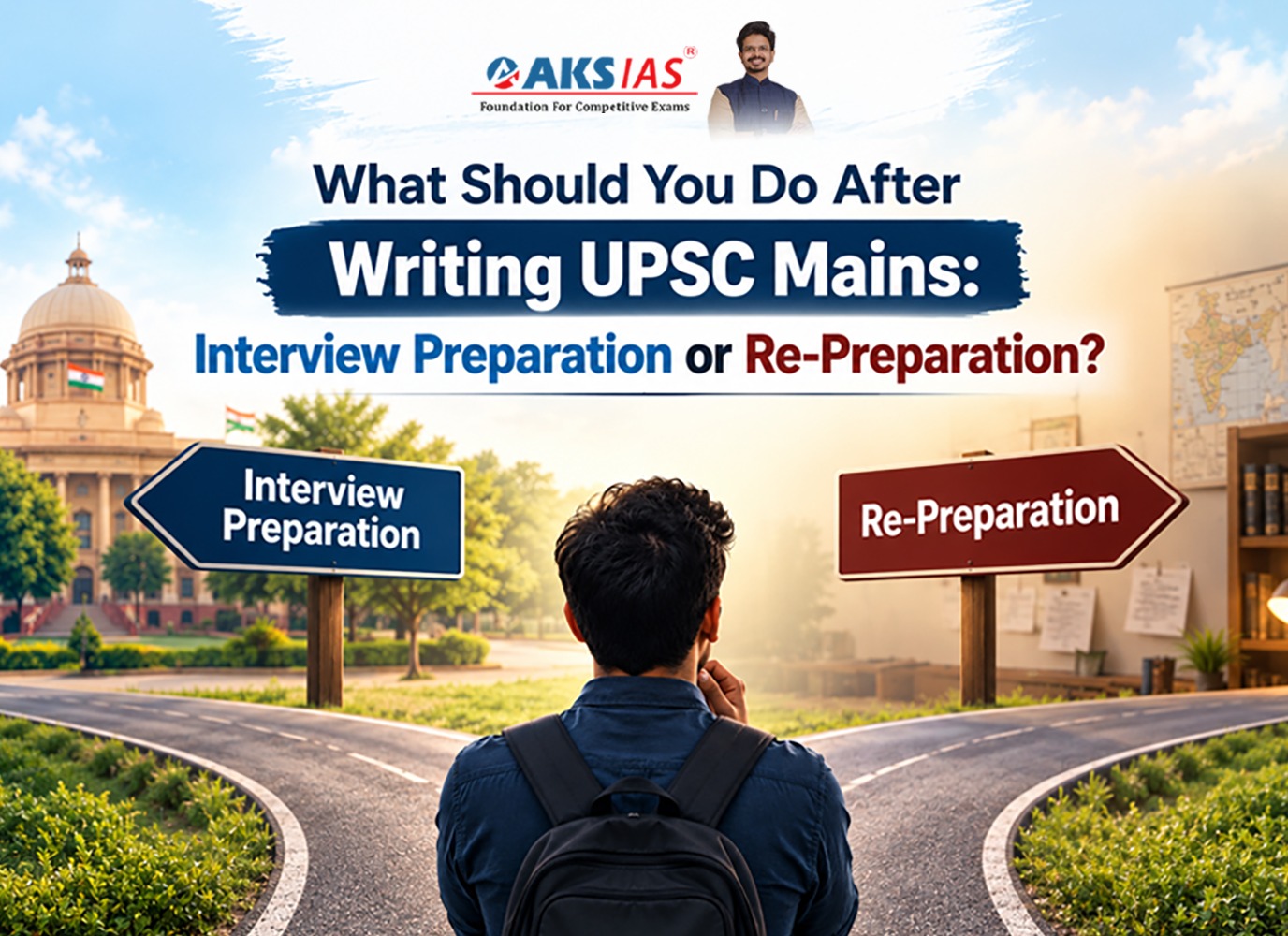
UPSC Mains exams are officially over. But it leaves candidates with very confusing options: should they start interview preparation, or should they continue studying the Mains syllabus just in case? Like everything in UPSC, there is no single answer to this question as well. The next steps depend on your intuition and confidence after taking the UPSC Mains exam. That will dictate which of the following paths you take:
- Start interview preparation
- Continue Mains/Prelims preparation
Let’s see what dictates this decision.
What Should You Do Immediately After UPSC Mains?
The foremost thing is to take a break. The UPSC Mains exam can be mentally and physically taxing. It is important to let your body and mind rest before you get on to something.
Once you have calmed & rested completely, you should conduct an honest assessment of your Mains performance:
- Did you complete most papers?
- How well did you understand the questions?
- Did you follow the directives?
- Were your answers properly structured?
- Did you manage time effectively?
- How did your Optional perform?
- How confident are you about Essay and Ethics?
We are not exactly grading your exam sheets. It is to determine whether Interview preparation or Mains re-preparation is the more rational use of your time. If you wait for this clarity until results, you are wasting a long time that could have been otherwise put to any preparation.
Should You Prepare for the Interview or Re-Prepare for Mains?
A simple decision framework is:
| Your Situation | Recommended Approach |
| Strongly confident about Mains | Start Interview preparation |
| Reasonably confident | Prioritise Interview preparation |
| Genuinely uncertain | Continue Mains preparation |
| Significant weaknesses in Mains | Mains re-preparation |
| Major gaps in Optional/GS | Strengthen Mains foundation |
| Mains result confirms qualification | Full Interview preparation |
| Mains result is negative | Analyse performance and execute next-attempt strategy |
Base your strategy on evidence, preparation level and risk management, not emotion.
Track 1: If You Are Confident About Clearing Mains
If you think you have realistic chances of clearing the UPSC Mains exams, you should start preparing for the Interview.
Start with Your DAF
The UPSC interview revolves mainly around your Detailed Application Form (DAF). Every detail you have provided can potentially become a question.
| Educational Background | Hometown & District | State | Hobbies |
| Your graduation subject | History | Economy | Every hobby will be discussed |
| Why you selected it | Geography | Governance challenges | Don’t list only because it sounds impressive |
| Important developments in the field | Economy | Major schemes | Deep exploration of hobbies also |
| Its relevance to society or administration | Culture | Geography | |
| Major development challenges | Politics & administration at a broad level | ||
| Important government initiatives | |||
| Local industries | |||
| Social issues |
Prepare Current Affairs Differently for the Interview
The UPSC Interview tests your depth and opinion formation. A simple “What happened?” can branch out to:
- Why did it happen?
- What are its implications?
- What would you do differently?
- What are the arguments on both sides?
- What is your opinion?
The most important areas in the interview include:
- National issues
- International developments
- Economy
- Governance
- Social issues
- Your state
- Your district
- Issues related to your educational or professional background
Develop Balanced Opinions
There is no perfect answer in the UPSC interview for any question. You just provide balanced (instead of opinionated) answers through a framework like this:
Issue
↓
Different perspectives
↓
Evidence
↓
Your reasoned view
↓
Practical way forward
Practise Mock Interviews
Like mock tests, mock interviews have proven to improve the final interview experience. These practices are also followed by the top IAS coaching in Hyderabad, for perspective. Here’s exactly what to evaluate:
- Communication
- Body language
- Clarity
- Confidence
- Listening ability
- Unnecessary hesitation
- Overlong answers
- Factual gaps
- Ability to handle disagreement
Goal ≠ Memorise model answers
Goal = More natural, composed and articulate answers
Track 2: If You Are Unsure About Your Mains Result
If you are unsure about succeeding in the Mains exam and think that it could go down the road, continuing your Mains preparation is the safer strategy. However, instead of thinking that you definitely failed, think more like:
“If I have to write Mains again, what would I do differently?”
Conduct a Mains Post-Mortem
For every paper:
| Content | Did I know enough about the topic? |
| Interpretation | Did I understand what the question actually demanded? |
| Structure | Did I provide a clear introduction, body and conclusion? |
| Time Management | Did I complete the paper? |
| Presentation | Were my answers readable and well organised? |
| Examples | Did I use relevant examples? |
| Revision | Could I recall information under exam pressure? |
What to Do from September to December
| Month | Objective | What To Do |
| September | Analyse & Repair | Mains performance analysis |
| Weak GS topics | ||
| Optional weaknesses | ||
| Answer-writing gaps | ||
| Essay weaknesses | ||
| Ethics preparation | ||
| October | Strengthen | GS revision |
| Optional consolidation | ||
| Previous Year Questions | ||
| Answer writing | ||
| Essay practice | ||
| Ethics case studies | ||
| November | Integrate | Static concepts |
| Current affairs | ||
| Examples | ||
| Data | ||
| Government initiatives | ||
| Answer writing under time constraints | ||
| December | Consolidate | Short notes |
| PYQs | ||
| Optional revision | ||
| Weak topics | ||
| Essay | ||
| Ethics | ||
| Prelims bridge preparation |
January Onwards: Shift Towards Prelims
Once the calendar marks January, you transition your preparation from Mains to Prelims. Focus on:
- Static subjects
- Current Affairs
- MCQs
- Previous Year Questions
- Mock tests
- Revision
- CSAT
The principle is:
Post-Mains → Mains consolidation → January transition → Prelims-focused preparation
This way, you don’t lose the hold on your Mains syllabus and get enough time to prepare for Prelims as well.
What If You Are Confident but Don’t Clear Mains?
That’s not an issue—no preparation goes to waste. Your Interview preparation may have improved:
- Current affairs understanding
- Communication
- Issue analysis
- Awareness of your background
Once the result is known, prepare accordingly.
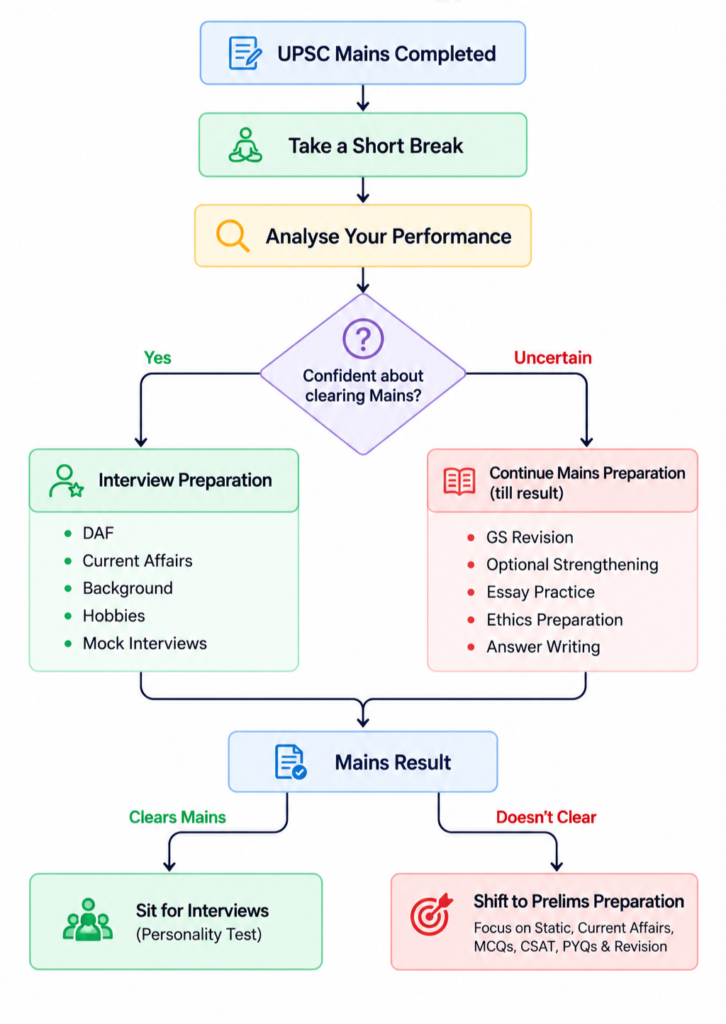
The Post Mains Strategy in One Flow
Final Takeaway
The gap between UPSC Mains and the declaration of its results is not a complete relaxation zone. You can take some rest initially, but you should return to preparation according to your confidence level in the exam that you have taken. Follow the two-track strategy:
- Confident about Mains → Start Interview preparation.
- Uncertain about Mains → Continue Mains preparation until January, then transition towards Prelims.
If you need additional guidance, you should take guidance from the best UPSC institutes in Hyderabad, like AKS IAS, for instance, to get on track with whatever suits you best.
Frequently Asked Questions (FAQs)
What to do after UPSC Mains?
Just after writing the UPSC Mains exam, take a short break. Then get back to Mains preparation if you are underconfident about the results, or start interview preparation if you are confident enough.
What are some common mistakes that students make after UPSC Mains?
The top 10 UPSC coaching in Hyderabad highlight these mistakes among Mains aspirants after taking the exam:
- Waiting completely for the result
- Starting interview preparation without assessing your Mains performance
- Immediately switching to Prelims
- Repeating the same strategy
- Changing your optional impulsively
- Ignoring Essay and Ethics
- Overthinking the result
What should I revise after UPSC Mains?
GS, Optional, Essay, Ethics and answer-writing weaknesses.