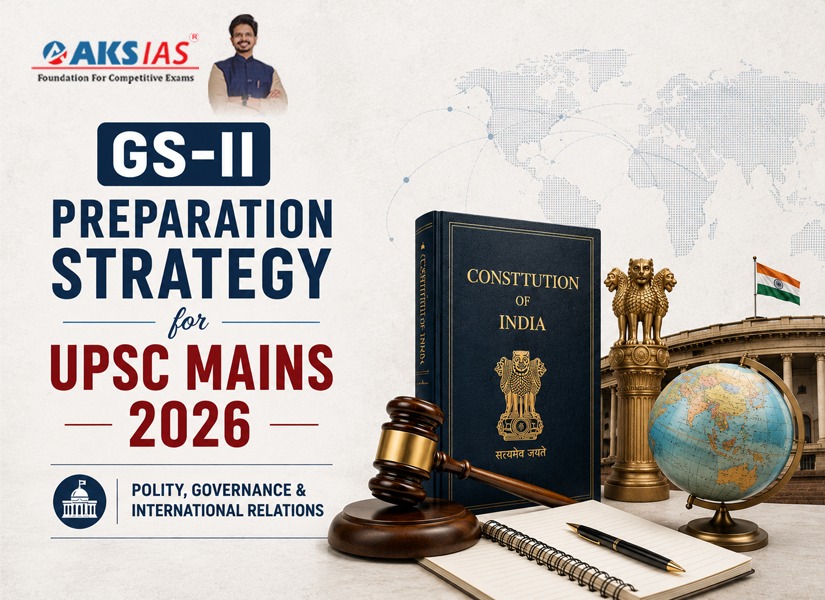
UPSC Mains is where most students struggle in their civil services journey. The GS-II paper is at the core of this struggle. Because the paper often feels unpredictable. It evaluates your understanding of governance, constitution & polity, social justice, and international relations (IR). The reason most people struggle with the paper is that they prepare without a clear strategy. This guide will outline the GS-II preparation strategy UPSC Mains 2026 demands.
Understanding GS-II in UPSC Mains
GS-II is at the heart of the UPSC exam. It covers:
- Indian Constitution
- Governance
- Parliament & Judiciary
- Federalism
- Welfare schemes
- Social justice
- International Relations (IR)
Unlike the other UPSC Mains papers, the GS-II paper is oriented towards the analytical and current affairs aspects. The latter has been confirmed with a deep analysis of the latest UPSC exam papers. Static questions are no longer asked, and they have been integrated with current governance or international developments.
For the scope of UPSC GS Paper 2 preparation strategy, we will cover the three main areas: Polity, Governance, and International Relations (IR).
Polity Preparation Strategy
- Build Conceptual Clarity
The integration of static + current affairs doesn’t mean you should focus only on reading articles. You should initially focus on a strong conceptual foundation in these key areas:
- Constitution
- Parliament
- Judiciary
- Federalism
- Constitutional bodies
- Electoral reforms
Understand the history, mechanism, and implications behind these.
- Link Current Affairs with Static Concepts
| Static Topic | Current Link |
| Separation of powers | Judicial activism debate |
| Federalism | Centre-state conflicts |
| Parliament | Anti-defection discussions |
This strategy instantly improves the weight of your answers.
- Focus on Governance Application
UPSC increasingly asks:
- Reform-oriented questions
- Institutional effectiveness
- Accountability mechanisms
The more connected you are to the practical implementation, the better.
Governance Preparation Strategy
Governance is among the most ignored sections of the GS-II paper. Since polity and governance are often conflated, most students focus solely on Polity and fail to develop an understanding of governance.
Use Real Examples
The key is to focus on the following topics:
- Transparency
- Accountability
- E-governance
- Citizen charters
- NGOs and SHGs
- Welfare delivery systems
Link them with the actual initiatives, reforms, and case studies for effective presentation.
Follow the Problem → Cause → Impact → Solution Model
You should follow this framework to standardize and improve the effectiveness of your answers.
For instance, let’s take “Delay in welfare delivery” as the assigned topic. The framework flow should be like this:
- Problem: Poor implementation
- Cause: Bureaucratic inefficiency
- Impact: Exclusion of beneficiaries
- Solution: Technology integration & monitoring systems
International Relations (IR) Strategy
- Understand the Background
Instead of just memorizing events, understand how they relate to these topics:
- India’s bilateral relations
- Regional groupings
- International organizations
- Geopolitics
- Global conflicts
- India’s strategic interests
- Learn Issue-Based Analysis
For every issue, prepare:
- Significance
- Challenges
- India’s position
- Way forward
- Focus on India-Centric Perspective
Remember that you are there competing for the Indian civil services. Align all your answers with India’s interests. However, it doesn’t mean that you should display ideological or emotional responses.
Static + Current Affairs Integration Strategy
Static subjects provide the framework. Current affairs provide relevance and examples.
| Static Topic | Current Affairs Link | |
| Polity | Fundamental Rights | Data privacy debates |
| Governance | Citizen charters | Digital governance reforms |
| International Relations (IR) | Non-Alignment Movement (NAM) | India’s strategic autonomy in global conflicts |
GS 2 Answer Writing Strategy
Good preparation doesn’t pay you back directly, good presentation does. A good answer in an UPSC exam includes:
- Constitutional references
- Committee recommendations
- Supreme Court judgments
- Government initiatives
- Balanced arguments
- Political unbiasedness
- Multi-dimensional arguments
Ideal Answer Structure
| IntroductionDefinitionContextExample |
| BodyMultiple dimensionsChallenges + solutionsAnalytical points |
| ConclusionNeutral SummaryFurther Reforms |
Best Sources for GS-II
Your GS 2 Polity Governance IR strategy shouldn’t rely on multiple sources. Focus on the valuable ones.
| Polity | Governance | International Relations (IR) |
| Standard textbook | Government reports | Newspaper analysis |
| Current affairs | Administrative examples | Issue-based notes |
| Editorial analysis | MEA-related developments |
Time Allocation Strategy for GS-II
A simple discussion at UPSC coaching in Hyderabad, for instance, will provide you with the following time balance:
| Area | Approximate Focus |
| Polity | 40% |
| Governance & Social Justice | 30% |
| International Relations | 30% |
Conclusion
The one takeaway from this guide is that to ace the GS-II paper, you shouldn’t focus solely on the conceptual or the current affairs aspect. Instead, you should focus on integrating the static concepts with current affairs. Further, presentation should be the utmost priority to portray yourself as a competent administrator. You can simplify this process by joining a UPSC coaching in Vizag, such as AKS IAS, which teaches you to make GS-II one of the most scoring papers in the exam.
Frequently Asked Questions (FAQs)
How to prepare GS 2 for UPSC Mains?
Focus on building conceptual knowledge with current awareness. Present your answers in a structured framework when answering GS-II questions.
What are the common mistakes to avoid in the GS-II paper?
- Memorizing articles without understanding
- Writing generic governance answers
- Ignoring current affairs
- Using emotional or ideological language
- Lack of structure in answers
- No examples or case studies