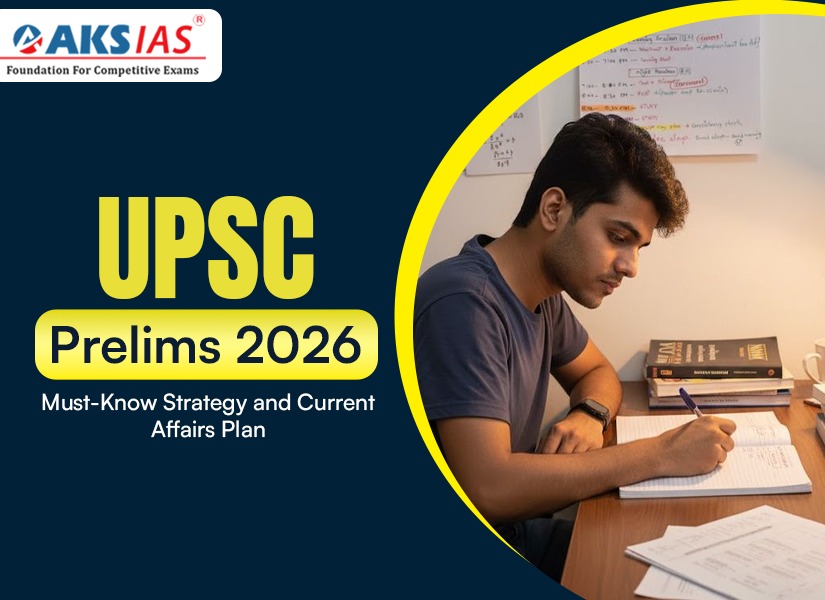
UPSC observes a massive number of aspirants every year. And while everyone is serious about UPSC overall, aspirants are generally found using underwhelming strategies for the Prelims exam. However, this can be devastating to your overall UPSC performance. The Prelims exam decides your qualification for the Mains exam. Further, the Prelims exam has evolved, with questions becoming more conceptual, statement-based, and indirect. This blog will be your guide to UPSC Prelims 2026, and we’ll lay out a practical strategy and plan, and help you ace the exam.
Understanding the Nature of UPSC Prelims 2026
Prelims consist of two objective-type papers, namely:
- General Studies I – 100 questions | +2 marks | -0.67 marks
- Civil Services Aptitude Test (CSAT) – 80 questions | +2.5 marks | -0.83 marks
Paper I determines the merit. Paper II requires 33% marks for qualification.
Attempting all questions is less significant than attempting as many questions as possible correctly.
UPSC Prelims Strategy 2026: Core Pillars for Success
The following sections highlight the most critical aspects of the UPSC Prelims strategy 2026.
- Subject Prioritization
Do not treat all subjects as equal. Some subjects carry more weight than others, and designing a strategy with priorities in mind will help you a lot.
| High-Yield Core | Medium Priority | Low/Unpredictable |
| Polity | Modern History | Culture-heavy facts |
| Environment & Ecology | Basic Science & Technology | Isolated current affairs trivia |
| Economy | ||
| Geography |
- Static + Current Affairs Integration
The new UPSC pattern fuses static subjects with current affairs. That also demands an instrumental change in your preparation strategy. To illustrate this, if you’re preparing for ecology basics, prepare for environmental news in parallel. For other subjects, this would look like economic policy for macro fundamentals, and polity issues for constitutional provisions. The best online coaching for UPSC is already structuring their studying plans accordingly.
- Attempt Strategy
One of the primary mistakes students make is attempting all the questions in the Prelims paper. Always be mindful of the negative marking for incorrect answers. The approach is simple:
- Sure questions: Don’t double-think, answer confidently.
- Doubtful: Use elimination method, and answer accordingly.
- Blind Guesses: Avoid at all costs—does more harm than good.
- Mastering Elimination Techniques
Acing the Prelims exam is not about knowing all the correct answers, but possessing excellent elimination skills. This skill can help you score marks where it appears to be a mere possibility of the same. Here is how you should eliminate:
- Extreme words like always, never, only, completely, etc.
- Contradictory pairings among options
- Known concepts with different terminology
- Mock Test Strategy
Without mock tests and PYQ practice, your complete preparation goes in vain. However, don’t think of these tests as final performance indicators, but rather as diagnostic tools. You should use mock tests to:
- Track accuracy
- Identify error patterns
- Note subjects where elimination fails
- Improve time management
UPSC Prelims Current Affairs Plan
The following UPSC Prelims current affairs plan will help you integrate (not overwhelm) current affairs with preparation.
| Focus | Avoid |
| Issues | Daily newspaper notes |
| Themes | Trivia memorization |
| Subject linkages | Multiple monthly compilations |
A 12-15 month window for collecting current affairs is ideal. Keep revisions as your periodic priority—2-3 rapid revisions before exams, otherwise quarterly.
Common Mistakes That Cost Aspirants Prelims Every Year
- Choosing multiple sources, leading to information overload
- Not giving revision the importance
- Delaying CSAT preparation until very late
- Over-attempting, leading to higher risks of negative marking
- Overlapping Mains and Prelims preparation strategies
- Panicking in the final month
Conclusion
The blog’s crux is simple: the UPSC Prelims exam has transformed, and so should the preparation. UPSC Prelims 2026 exam values clear thinking more than content overload. A structured strategy, intelligent planning, and disciplined revision will provide exponential rewards in the exam. A coaching institute like AKS IAS helps you prioritise based on importance and ace Prelims calmly.
Frequently Asked Questions (FAQs)
How many questions should I attempt in Prelims?
There is no fixed number. The attempt depends on the paper’s accuracy and difficulty.
Are current affairs more important than static subjects?
No. Static subjects form the base; current affairs act as triggers.
How many mock tests are enough?
Fewer mocks with deep analysis are better than many without review.